Heavy earthmoving equipment works in some of the toughest operating conditions imaginable. Dust, heat, vibration, heavy loads and long operating hours all place enormous strain on components.
While parts are designed to withstand demanding conditions, no component lasts forever.
The good news is that machinery will often give you warning signs before a component fails completely. Recognising these signs early can help prevent secondary damage, reduce unexpected downtime and allow maintenance teams to plan repairs rather than react to breakdowns.
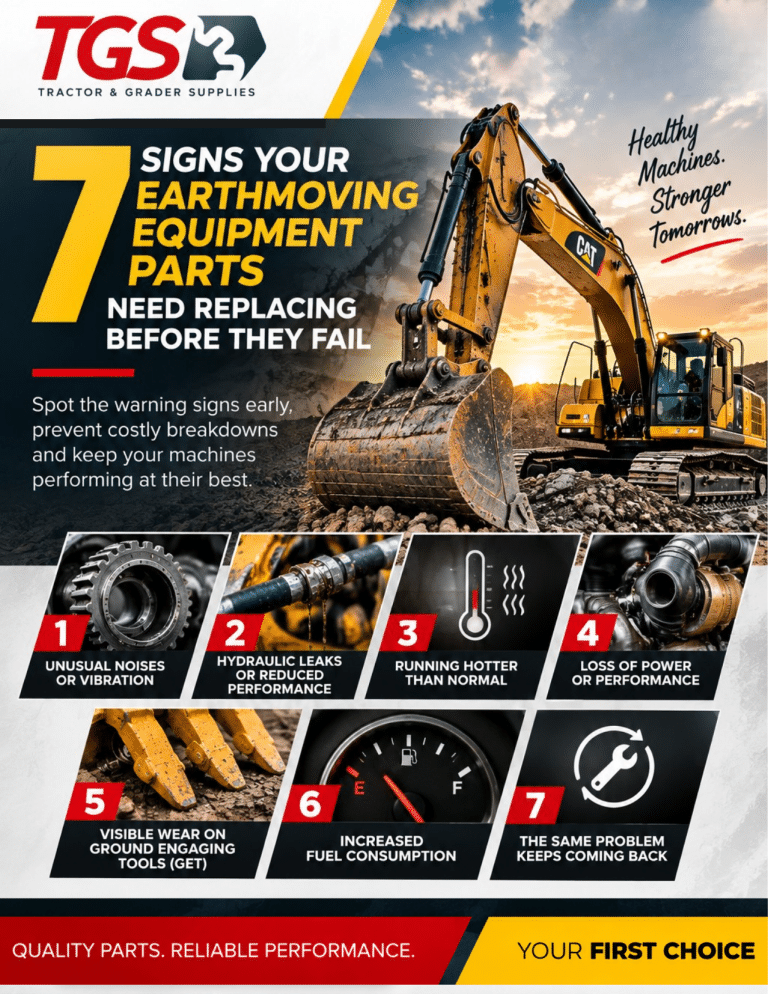
Here are seven warning signs that your earthmoving equipment may be telling you it’s time to inspect or replace a component.
Operators become familiar with how their machines normally sound and feel. New grinding, knocking, squealing or rattling noises should never be ignored.
Likewise, excessive or unusual vibration can indicate wear in components such as:
A relatively small worn component can sometimes cause additional stress elsewhere in the machine. Investigating unusual noises and vibrations early may help prevent a much larger repair later.
Your machine’s hydraulic system is responsible for transferring the power needed to perform demanding tasks.
If hydraulic equipment starts responding slowly, loses lifting power or becomes inconsistent, there may be an issue within the hydraulic system.
Look out for signs such as visible hydraulic leaks, slow cylinder movement, reduced lifting capacity, unusual hydraulic noises or overheating.
Depending on the cause, components such as pumps, cylinders, hoses, seals or other hydraulic parts may require inspection or replacement.
Don’t simply keep topping up hydraulic fluid without determining why the level is dropping.
Overheating is another warning sign that shouldn’t be ignored.
Heavy equipment cooling systems need to operate effectively under demanding loads and high ambient temperatures. Problems with radiators, fan drives, oil coolers, reversible fans or other cooling-system components can cause operating temperatures to increase.
A machine consistently running hotter than usual warrants investigation.
Has the machine started feeling sluggish?
Perhaps it isn’t delivering the same power under load, takes longer to complete tasks or simply doesn’t perform as it previously did.
Reduced performance can have numerous causes, including issues involving the engine, fuel injection system, filters, turbocharger, hydraulic system or power train.
Rather than accepting declining performance as a normal consequence of an ageing machine, investigate the cause.
Ground Engaging Tools – commonly known as GET – operate directly against abrasive materials and are consequently exposed to significant wear.
Bucket teeth, cutting edges, adapters and other wear components should be inspected regularly.
Watch for:
Allowing GET components to wear beyond their recommended limits can affect productivity and potentially expose more expensive bucket components to unnecessary damage.
Replacing wear parts at the appropriate time can therefore protect far more than the component itself.
If a machine suddenly starts consuming more fuel while performing the same work, something may have changed.
Restricted filters, fuel-system problems, worn engine components, turbocharger issues or increased mechanical resistance can all contribute to reduced efficiency.
Fuel consumption should therefore be viewed as more than simply an operating expense – changes in consumption can provide valuable information about machine condition.
If you’re repeatedly repairing the same issue, it may be time to look beyond the immediate symptom.
Recurring failures can indicate an underlying worn component, an incorrect replacement part, improper installation or another component placing excessive stress on the system.
Repeated temporary repairs can quickly become expensive when you factor in labour, replacement parts, lost production and machine downtime.
Finding the root cause and using the correct replacement component can provide better long-term value.
The best time to identify a worn component is before the machine stops working.
Regular inspections, scheduled servicing and careful attention to operator feedback can help maintenance teams identify developing problems early.
When replacement parts are required, correct part identification and component quality are equally important.
TGS supplies an extensive range of replacement parts and components for earthmoving and mining machinery, including engine components, hydraulics, power train components, GET and wear parts, filters, cooling-system components, electrical parts, bearings and more.
Looking for the Right Replacement Part?
Speak to the TGS team.
| Cookie | Duration | Description |
|---|---|---|
| cookielawinfo-checkbox-analytics | 11 months | This cookie is set by GDPR Cookie Consent plugin. The cookie is used to store the user consent for the cookies in the category "Analytics". |
| cookielawinfo-checkbox-functional | 11 months | The cookie is set by GDPR cookie consent to record the user consent for the cookies in the category "Functional". |
| cookielawinfo-checkbox-necessary | 11 months | This cookie is set by GDPR Cookie Consent plugin. The cookies is used to store the user consent for the cookies in the category "Necessary". |
| cookielawinfo-checkbox-others | 11 months | This cookie is set by GDPR Cookie Consent plugin. The cookie is used to store the user consent for the cookies in the category "Other. |
| cookielawinfo-checkbox-performance | 11 months | This cookie is set by GDPR Cookie Consent plugin. The cookie is used to store the user consent for the cookies in the category "Performance". |
| viewed_cookie_policy | 11 months | The cookie is set by the GDPR Cookie Consent plugin and is used to store whether or not user has consented to the use of cookies. It does not store any personal data. |
WhatsApp us
