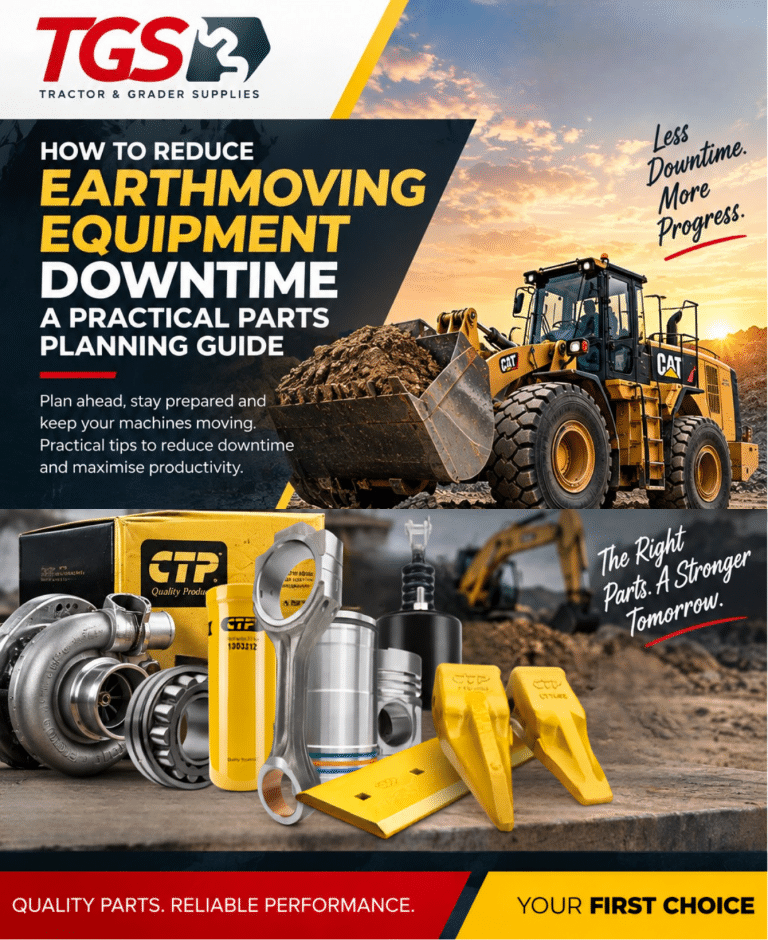
In earthmoving, construction and mining operations, a machine that isn’t working isn’t producing.
Unexpected downtime can affect far more than a single piece of equipment. One breakdown can disrupt production schedules, delay other machines, increase labour costs and place pressure on maintenance and procurement teams.
Although not every breakdown can be prevented, effective parts planning can help businesses reduce unnecessary downtime and respond more efficiently when maintenance is required.
Here are some practical ways fleet managers, workshop teams and procurement departments can improve replacement-parts planning.
Not every machine presents the same operational risk.
Start by identifying the equipment that would have the greatest impact on production if it stopped unexpectedly.
Consider factors such as:
Machines operating continuously or performing specialised tasks may require a different parts strategy from equipment that is used occasionally.
Maintenance records are one of the most useful tools available to fleet managers.
Review previous repairs and identify components that are regularly replaced.
Depending on the equipment and application, these could include filters, bearings, hoses, seals, GET and wear parts, braking components, electrical components and other service items.
Understanding your fleet’s historical consumption helps procurement teams anticipate demand rather than waiting for the next breakdown.
Stocking every possible component isn’t practical or financially sensible.
The objective is to identify the parts where availability could significantly affect downtime.
Ask three questions:
Good inventory planning is therefore about balancing cost, availability and operational risk.
There’s a major difference between planned maintenance and emergency maintenance.
When wear is identified during a scheduled inspection, the maintenance team can order the required parts, allocate workshop time and plan around production.
When a component fails unexpectedly, those options disappear.
The machine stops first – and everything else becomes urgent.
Regular inspections can help identify deterioration in components such as bearings, hoses, filters, hydraulic components, GET, cooling-system components and powertrain parts before complete failure occurs.
One of the simplest ways to reduce delays when ordering replacement parts is to maintain accurate equipment records.
For each machine, keep details such as:
Having this information readily available helps your parts supplier identify the correct component more efficiently.
It also reduces the risk of ordering an incorrect part and losing additional time through returns and reordering.
The cheapest replacement component is not necessarily the lowest-cost option over the life of the machine.
A part that wears prematurely or performs poorly can result in additional labour, repeated replacement and further downtime.
When evaluating replacement parts, procurement teams should consider quality, suitability for the application, expected service life, availability and supplier support alongside price.
For hardworking earthmoving and mining machinery, reliability has a direct impact on operating costs.
When a machine is standing, searching for a supplier shouldn’t be the first step.
Working with an established replacement-parts supplier gives your maintenance and procurement teams a reliable point of contact when components are required.
A good supplier should be able to assist with part identification, product availability, suitable replacement options and technical product information.
TGS supports customers through a branch network across Southern Africa and supplies a comprehensive range of replacement components for earthmoving and mining equipment.
Service intervals provide an opportunity to move from reactive purchasing to planned procurement.
If you know that machines are approaching scheduled services or major component inspections, parts can be sourced beforehand.
This allows procurement teams to consolidate orders, check availability and ensure components are ready before the machine enters the workshop.
Planning becomes particularly important when several machines in a fleet have similar service intervals.
Reducing equipment downtime isn’t simply a workshop responsibility.
It requires cooperation between operators, maintenance teams, fleet managers, procurement departments and parts suppliers.
Operators identify changes in machine behaviour. Maintenance teams diagnose wear. Procurement ensures replacement parts are available. Suppliers help identify and source the correct components.
When these functions work together, maintenance becomes more proactive and less reactive.
Plan Ahead With TGS – Your First Choice.
| Cookie | Duration | Description |
|---|---|---|
| cookielawinfo-checkbox-analytics | 11 months | This cookie is set by GDPR Cookie Consent plugin. The cookie is used to store the user consent for the cookies in the category "Analytics". |
| cookielawinfo-checkbox-functional | 11 months | The cookie is set by GDPR cookie consent to record the user consent for the cookies in the category "Functional". |
| cookielawinfo-checkbox-necessary | 11 months | This cookie is set by GDPR Cookie Consent plugin. The cookies is used to store the user consent for the cookies in the category "Necessary". |
| cookielawinfo-checkbox-others | 11 months | This cookie is set by GDPR Cookie Consent plugin. The cookie is used to store the user consent for the cookies in the category "Other. |
| cookielawinfo-checkbox-performance | 11 months | This cookie is set by GDPR Cookie Consent plugin. The cookie is used to store the user consent for the cookies in the category "Performance". |
| viewed_cookie_policy | 11 months | The cookie is set by the GDPR Cookie Consent plugin and is used to store whether or not user has consented to the use of cookies. It does not store any personal data. |
WhatsApp us
